Canister vs Hang On Back Filters: Which Is Better?
November 21, 2026
Canister filter or hang on back: which is better for my tank?
For most freshwater tanks up to 40 to 55 gallons with a moderate stocking level, a hang on back filter is the more practical choice. For tanks of 55 gallons and larger, heavily stocked tanks, or tanks housing messy fish such as goldfish, oscars, or large cichlids, a canister filter is the stronger option and at 75 gallons and above it becomes close to necessary rather than merely preferable. Neither filter is universally better. The right answer comes from matching the tool to your tank's actual demands.
What these two filters actually are
A hang on back filter, often called an HOB, clips onto the rim of the tank. A tube draws water up from inside the tank, pushes it through a media chamber hanging behind the glass, and returns it over a lip that cascades back into the tank. Setup takes minutes and the filter is always visible, which makes checking on it easy.
A canister filter sits in the cabinet below the tank. Water travels down an intake tube, passes through a pressurized sealed housing packed with filter media, and is pushed back up a return tube and into the tank through a spray bar or nozzle. The motor and media are entirely hidden.
Both run the nitrogen cycle the same way: beneficial bacteria colonize the media surface and convert ammonia to nitrite and then to nitrate. The difference is in how much media each type can hold, how loud each runs, how often each needs servicing, and what that servicing involves.
Where HOB filters win
Ease of maintenance is the HOB's clearest advantage. Rinsing or swapping the media basket takes 5 to 10 minutes without disconnecting anything or carrying a water-filled housing to the sink. Because the job is quick, hobbyists are more likely to do it on schedule. In practice, that consistency can translate to better water quality than a canister that gets put off for months.
Lower upfront cost also works in the HOB's favor. Even the most feature-rich HOB units land substantially below the $100 to $400 price range that entry-level to mid-range canisters occupy. If budget is tight, a quality HOB gets you reliable filtration without a large initial outlay.
Simple setup matters for beginners. There are no hoses to prime, no O-rings to reseat, and no risk of a slow leak developing at a hose connection. The filter is running within a few minutes of unboxing.
HOBs are well suited to tanks up to roughly 40 to 55 gallons carrying moderate bioloads. Inside that range they perform reliably and are genuinely easy to keep running well.
Where HOB filters lose
HOB filters produce audible sound. Filtered water cascades back into the tank over an overflow lip, creating a waterfall noise that becomes louder when the tank water level drops and the fall distance increases. The motor can also generate humming or vibration against the tank wall. For a tank in a bedroom or a quiet living space, this matters.
HOB filters also hold significantly less media than canisters. Even the AquaClear 50, one of the most spacious HOB units available, holds roughly 1.5 liters of media. Less media volume means less surface area for beneficial bacteria and less room to layer multiple media types.
Maintenance frequency is higher. HOB media typically needs rinsing or replacing every one to four weeks depending on stocking level. That is a reasonable cadence, but it is more hands-on time per year than a canister requires.
Finally, HOB intakes can injure or kill small fish, fry, shrimp, and delicate invertebrates by drawing them against the screen or through the impeller. Fitting a sponge pre-filter over the intake tube reduces this risk and is a worthwhile precaution in any tank housing small or fragile animals.
Where canister filters win
Media capacity is the canister's headline advantage. As a concrete example, the Fluval 207 holds roughly 4.8 liters of media across four separate baskets. That is more than three times the capacity of the AquaClear 50. Greater volume means more surface area for beneficial bacteria, more room for chemical media such as activated carbon or phosphate remover, and genuine flexibility to stack different media types in a deliberate sequence.
Noise is another meaningful win. Because the motor and media sit inside a sealed housing outside and below the tank, the operating sound is significantly lower than a comparable HOB. There is no waterfall splash, and the motor is decoupled from the glass.
Long-term running cost favors canisters once the upfront price is absorbed. Canister filters use bulk reusable media, so there are no proprietary replacement cartridges to purchase on a recurring schedule. HOBs can be run cost-effectively too by replacing cartridges with reusable foam and loose bio-media, but canisters are designed around that approach from the start.
For tanks of 55 gallons and larger, heavily stocked tanks at any size, and tanks with large or messy fish, canisters are the preferred choice across multiple sources.
Where canister filters lose
Upfront cost is the obvious drawback. Entry-level to mid-range canisters run $100 to $400, which is a real barrier for a beginner setting up a first tank.
Maintenance complexity is significant. Disconnecting hoses, carrying the housing to a sink, disassembling media baskets, cleaning the impeller, and reassembling with the O-ring properly seated typically takes 30 to 45 minutes. That is not difficult, but it is involved enough that some hobbyists delay it longer than they should.
Advertised flow rates are misleading. Canister GPH ratings are measured at the pump head with no media loaded and no hose attached. In real-world use, after accounting for hose friction, media resistance, tubing bends, and vertical lift, actual throughput falls to roughly one-half to two-thirds of the rated figure. The Rena Filstar XPL, for example, is rated at 350 GPH but delivers around 187 GPH through a loaded filter. Plan for that gap when choosing a model.
One practical step that helps both noise and maintenance is adding a sponge pre-filter to the canister intake. It catches coarse debris before it reaches the media baskets and extends the servicing interval toward the longer end of the two-to-six-month range that a well-loaded canister on a normally stocked tank requires.
When the answer is clear either way
Choose an HOB when: your tank is 40 to 55 gallons or smaller, your stocking is moderate, your budget is limited, or you want the simplest possible maintenance routine.
Choose a canister when: your tank is 55 gallons or larger, you keep large or messy fish, your tank is heavily stocked, you want lower ongoing media costs, or quieter operation is a priority.
Consider a sponge filter instead of either if you are setting up a breeding tank, a fry tank, a quarantine or hospital tank, or a shrimp tank. Sponge filters powered by an air pump produce a gentle diffuse flow that does not trap or injure fry or juvenile shrimp, they harbor no chemical media that could interfere with medications, and a pre-seeded sponge can be transferred to a new tank immediately to establish its nitrogen cycle.
Cost and maintenance over time
Upfront, an HOB is cheaper. Over a few years, however, recurring cartridge costs can add up if you use proprietary replacements. Switching an HOB to reusable foam and loose bio-media brings that cost down considerably. Canisters use bulk reusable media by default, so once the initial purchase is paid off the per-year running cost is lower.
Maintenance time per session strongly favors the HOB at 5 to 10 minutes versus 30 to 45 minutes for a canister. But canisters need full servicing only every two to six months, while HOB media needs attention every one to four weeks. Add it up for your situation. The canister wins on total annual hands-on time for most tanks, but only if you actually do the service when it is due rather than deferring it because the job feels large.
Frequently asked questions
Can I run both a canister and an HOB on the same tank?
Yes, and doing so is a practical strategy for heavily stocked tanks or tanks recovering from a disease treatment that required removing chemical media. Running two filters also provides a backup if one needs servicing or fails, and an HOB seeded with established media from a canister can jump-start a new tank's cycle.
Do I need to worry about flow rate advertising on canisters?
You do. Rated GPH on canisters is measured with no media and no hoses connected. Real-world throughput typically falls to one-half to two-thirds of the advertised number once media resistance, hose friction, and vertical lift are factored in. When comparing models, look for measured real-world flow data rather than the pump-head rating on the box.
Will a HOB filter hurt my shrimp or small fish?
The intake can draw small animals against the screen or through the impeller. Fitting a foam sponge pre-filter over the intake tube reduces this risk substantially and is a simple, low-cost addition to any HOB used in a shrimp or fry tank.
How often does a canister filter really need cleaning?
A properly loaded canister on a normally stocked tank typically needs full servicing every two to six months. Adding a sponge pre-filter to the intake extends that interval toward the longer end by catching coarse debris before it reaches the media baskets. Tanks with heavy bioloads or large messy fish will push servicing toward the shorter end of the range.
Is there a situation where neither a canister nor an HOB is the right answer?
Yes. Breeding tanks, fry tanks, quarantine and hospital tanks, and shrimp tanks are better served by a sponge filter run on an air pump. The gentle flow protects fragile animals, the sponge biofilm provides supplemental food for shrimp and fry, and the absence of chemical media means medications work without interference.
If you are unsure whether your filter is actually keeping up with your tank's demands, TankMind's /diagnose tool can help you pinpoint the issue from your actual water readings.
Want to keep your own tank steady? Track your parameters free with TankMind.
If this was useful, this tells Google to surface TankMind more often in your Search results.
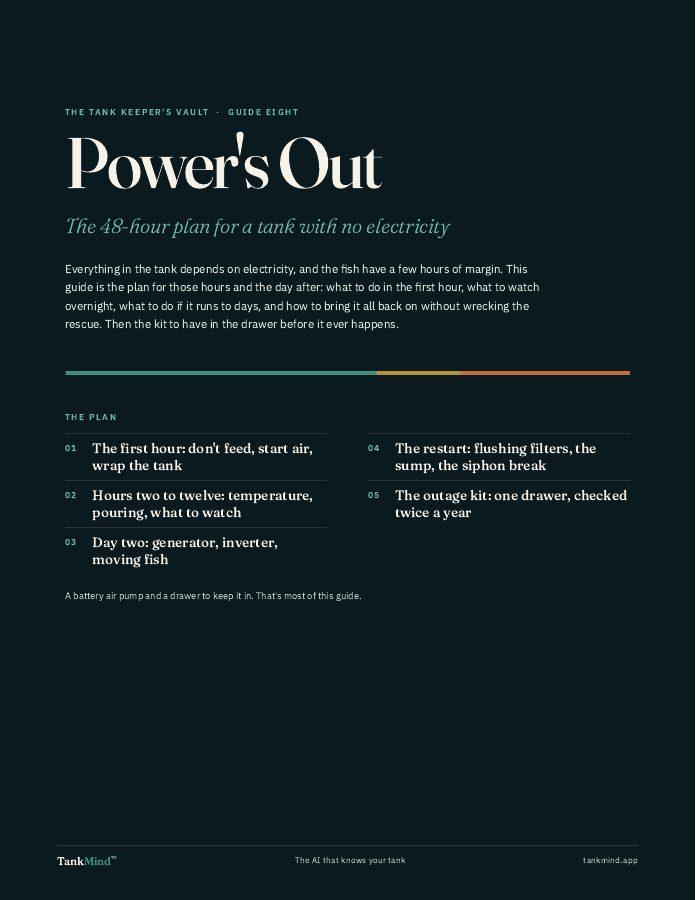
Power's Out
The 48-hour plan for a tank with no electricity
Get the free guideStart your free tank log