Neon Goby Care Guide for Saltwater Tanks
November 10, 2026
Is the Neon Goby a good beginner saltwater fish?
The Neon Goby (Elacatinus oceanops) is rated as a beginner-level marine fish, making it one of the more approachable choices for aquarists who are new to reef keeping. It is reef safe, peaceful by temperament, and tops out at a maximum adult size of 2 inches, which keeps its footprint inside the tank small and its impact on water chemistry modest. Beyond its ease of care, it performs a genuinely useful job in a reef system by establishing cleaning stations and picking parasites off larger fish, a behavior that makes it both interesting to watch and practically beneficial to the rest of the tank's population.
What is the Neon Goby and who should keep one?
Also sold under the names Neon Cleaner Goby and Cleaner Goby, Elacatinus oceanops is a tiny carnivorous fish native to marine saltwater environments. Its claim to fame is its cleaning station behavior. In the wild and in captivity alike, it positions itself in a predictable spot and signals to larger fish that it is available for parasite removal. Larger fish, even species that would ordinarily eat a fish this small, recognize the signal and hold still while the goby works. Watching this interaction play out in a home reef tank is one of the more remarkable things the hobby has to offer.
The Neon Goby suits beginner to intermediate saltwater aquarists who want a fish with a defined role, predictable behavior, and tolerant water parameter needs. Because it can be bred in captivity relatively easily, it also appeals to aquarists who eventually want to try breeding marine fish without taking on a highly demanding species. Keeping it in pairs or small groups is recommended, so it fits naturally into community reef planning.
What tank and water conditions does the Neon Goby need?
The Neon Goby is a marine fish and belongs only in a saltwater setup. Within that setup, it is forgiving across a reasonable range of parameters. The temperature range it tolerates is 72 to 82 degrees Fahrenheit, the salinity range is 1.023 to 1.027 specific gravity, and the pH range sits between 8.1 and 8.4. Those are parameters that overlap comfortably with what most reef tanks already maintain for corals and other invertebrates, so there is rarely any conflict between keeping this fish and keeping a reef.
Because the Neon Goby is reef safe, it can be housed with corals, live rock, and invertebrates without risk of nipping or predation. Live rock in particular benefits this species because it provides the elevated perching spots where the fish likes to set up its cleaning station. A well-aquascaped reef tank with open water column access and high perch points gives the Neon Goby room to do exactly what it is built to do.
At a maximum adult size of 2 inches, the fish itself does not need enormous swimming space, but the data block does not specify a minimum tank size, so consult your specific stocking plan and filtration capacity rather than relying on a gallon figure not listed here. What matters most is stable water quality within the ranges above and tank mates that are compatible with a small, peaceful fish.
What does the Neon Goby eat?
The Neon Goby is a carnivore. Its natural diet centers on the parasites it picks from client fish at its cleaning station, but in a home aquarium it needs supplemental feeding to stay in good condition. It accepts mysis shrimp and small pellets, both of which are practical choices for a fish of this size. Small, frequent feedings tend to work well for a fish with a small stomach.
Target feeding is worth considering for the Neon Goby because larger, more aggressive feeders in a mixed community can outcompete a 2-inch fish at the water surface. Directing food close to where the goby perches gives it a fair chance to eat before faster fish claim the meal. Mysis shrimp can be delivered with a turkey baster or a feeding tube, placing food near the fish rather than releasing it into open water.
Variety within the bounds of carnivore-appropriate foods keeps the fish in better condition over the long term. Rotating between mysis shrimp and small pellets covers different nutritional profiles and prevents the fish from fixating on a single food source that might not be available consistently.
What tank mates work well with the Neon Goby?
The Neon Goby is peaceful, which means it does not initiate aggression and does not compete territorially in the way that many other gobies do. Its cleaning station behavior actually makes it attractive to a wide range of larger fish that benefit from parasite management. Peaceful community reef fish are natural neighbors, and the goby's size means it poses no threat to anything else in the tank.
The concern runs in the opposite direction. At 2 inches maximum, the Neon Goby is small enough to be eaten by larger predatory fish. Housing it with species that have a large enough mouth and an appetite for small fish is the main compatibility risk to avoid. The compatibility notes section of the data for this species is not populated with specific fish names, so this guide will not name individual species to avoid. The general principle is to build the tank around peaceful, similarly scaled reef inhabitants and to research any large fish you plan to add before introducing the goby.
Keeping Neon Gobies in pairs or small groups is recommended. They are social within their own kind and can form cleaning station partnerships that make the behavior more visible and consistent.
Common beginner mistakes with the Neon Goby
- Assuming it feeds itself entirely from cleaning. The parasites it picks from other fish are not a complete diet. Mysis shrimp and small pellets need to be offered regularly.
- Housing it with predatory tank mates. A 2-inch peaceful fish disappears quickly in a tank with large predators. Plan tank mates before purchasing.
- Keeping a single fish when pairs or small groups are recommended. The species does better socially when kept with its own kind.
- Ignoring water parameter stability. The Neon Goby tolerates a reasonable range of 72 to 82 degrees Fahrenheit and 1.023 to 1.027 specific gravity, but swings outside those ranges stress any marine fish.
- Missing feeding opportunities in a competitive tank. Small gobies lose out at community feeding time. Target feeding ensures they actually eat.
Frequently asked questions
Can a Neon Goby live in a reef tank?
Yes. The Neon Goby is explicitly reef safe and will not harm corals or invertebrates. Its preference for elevated perching spots on live rock makes a well-aquascaped reef tank a natural environment for this species.
How big does a Neon Goby get?
The Neon Goby reaches a maximum adult size of 2 inches. That small size is part of what makes it manageable for beginner aquarists and compatible with a wide range of reef setups.
Can you breed Neon Gobies in a home aquarium?
The Neon Goby can be bred in captivity relatively easily compared to many other marine fish. Keeping them in pairs creates the natural social conditions that support breeding behavior.
What do Neon Gobies eat in captivity?
In a home aquarium the Neon Goby accepts mysis shrimp and small pellets as the core of its carnivore diet. Its cleaning station behavior means it also consumes parasites from other fish, but that alone is not sufficient nutrition.
What water temperature does the Neon Goby need?
The Neon Goby does well across a temperature range of 72 to 82 degrees Fahrenheit, which aligns with the conditions most reef tanks already maintain.
If you want to log your tank parameters, track feeding schedules, or monitor how your Neon Goby is settling in alongside its tank mates, TankMind gives you a straightforward place to do exactly that.
Want to keep your own tank steady? Track your parameters free with TankMind.
If this was useful, this tells Google to surface TankMind more often in your Search results.
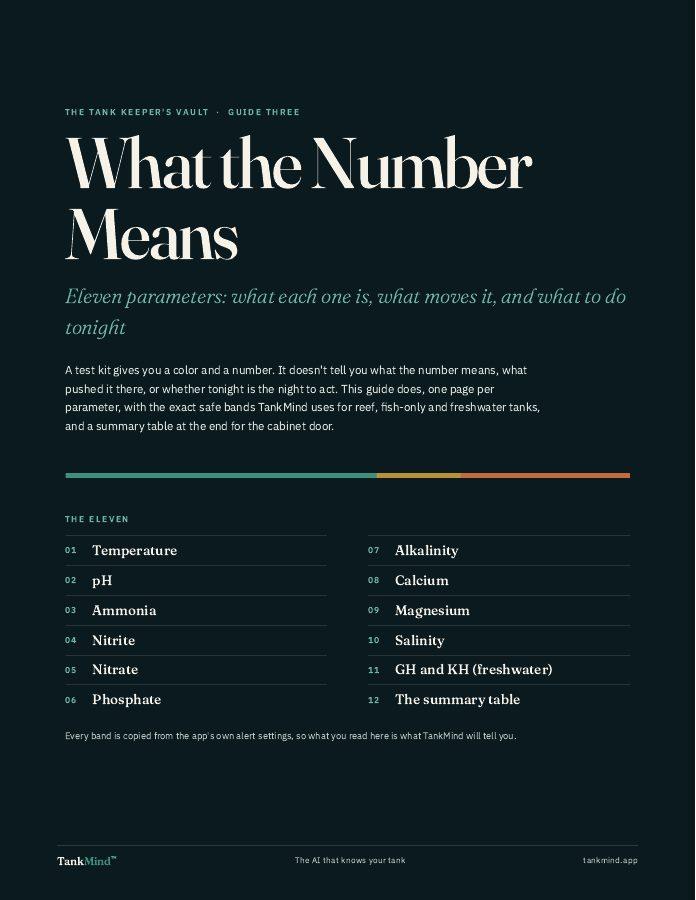
What the Number Means
Eleven parameters: what each one is, what moves it, and what to do tonight
Get the free guideStart your free tank log