Tropical Fish Don't Get Used to a Cold Room
November 20, 2026
Will Tropical Fish Get Used to a Cold Room Without a Heater?
No, they will not. Fish are ectotherms, meaning their body temperature follows the temperature of the water around them, and they have no biological mechanism to adapt to water that is colder than their healthy range. A cold room does not toughen up a tropical fish. It stresses the fish, suppresses its immune system, and sets the stage for disease. The rest of this article explains exactly why that happens, how to tell whether your tank is at risk, and what to do about it before something goes wrong.
Why Cold Water Is Not Something Fish Can Just Adjust To
The idea that fish might "get used to it" sounds reasonable because we see animals adapt to their environment all the time. With fish, the problem is more fundamental than that. Because a fish's metabolic rate depends directly on water temperature, cold water slows the fish's entire biology. Fish kept too cold become less active and eat less, which are early warning signs that the animal is under stress rather than signs that it is comfortable.
More seriously, cold water weakens a fish's immune system. A scientific review of fish immunity found that both short and prolonged exposure to temperatures below a species' optimal range generally suppress immune responses. The fish is not adjusting. It is simply less able to defend itself.
It is fair to say there is a small true part to this myth. Some tropical fish can tolerate water a few degrees cooler than recommended, at least for a short time. That tolerance is not adaptation, though, and keeping fish steadily at their correct temperature remains less stressful and helps prevent disease compared with keeping them at the edge of their range.
How to Tell Whether Your Tank Is Actually at Risk
The first step is to know your fish's specific temperature range. Not all fish sold as tropical share one range, so the right temperature should be checked for each species you keep. Most tropical community fish are kept at roughly 75 to 80°F, with some sources citing a tighter band of 76 to 80°F or 78 to 80°F.
The second step is to know what your water is actually doing, not what your heater's dial shows. A heater can fail or hold the wrong temperature, and its indicator light only tells you the heater is running, not that the water has reached the set point. Keep a separate thermometer in the tank and check it regularly, ideally every day. Place it at the opposite end of the tank from the heater so it shows whether warmth is actually reaching the far side of the aquarium.
If your thermometer is showing temperatures below your fish's range, especially after cold nights or during winter, your tank is at risk.
What to Do If Your Room Gets Cold in Winter
Get or size a heater correctly. Veterinary and trade guidance does not recommend keeping tropical fish without a heater in a home cooler than their temperature range. A common sizing guide is 3 to 5 watts per gallon. A tank in an especially cold room may need a larger heater or a second heater to hold temperature reliably.
Position the heater for even heat distribution. Place a submersible heater next to the filter outlet, a pump, or another spot with strong water flow so warmth spreads through the tank rather than pooling near the heater.
Reduce heat loss. A tight-fitting lid reduces the amount of heat escaping through the surface. Keep the aquarium away from draughts such as exterior doors, away from other heat sources that cycle on and off and cause swings, and out of direct sunlight.
Choose a larger tank if you have flexibility. Larger volumes of water change temperature more slowly, so a bigger aquarium holds a more stable temperature than a small one. Stability matters as much as the number on the thermometer.
Prepare for power outages. When a tank is at risk of getting too cold during a winter power cut, wrapping it in blankets or similar insulation slows cooling, as long as the water remains oxygenated.
Why Temperature Swings Are as Dangerous as Being Too Cold
A cold room does not just push the temperature down. It creates swings, and sudden changes of even a few degrees stress fish and can compromise their immune system. Fish kept in tanks with unstable temperatures tend to fall ill more often.
One of the most common consequences is ich, also called white spot disease. Ich outbreaks are linked to temperature changes, and a sudden drop in water temperature is a commonly cited trigger. Outbreaks of ich and some other parasites are also more common around seasonal transitions such as autumn and early spring, when rooms cool down faster than keepers expect. It is worth noting that cool water slows the ich parasite's life cycle rather than stopping it entirely, so low temperatures are not a treatment or a protection.
Are There Any Tropical Fish That Do Not Need a Heater?
A small number of species commonly found in tropical community tanks are actually temperate fish that can live without a heater, provided the room keeps the water within their own specific range. Zebra danios and white cloud mountain minnows are the most frequently cited examples.
White cloud mountain minnows are a cool-water species. One trade body gives their range as 17 to 23°C (about 62.6 to 73.4°F), and a specialist fish reference gives 14 to 22°C (about 57 to 72°F). If your room consistently stays within those bands through winter, white clouds can thrive without supplemental heating. The same logic applies to zebra danios within their own range. These fish are exceptions, not a general rule, and they should still be kept with a thermometer so you know what the water temperature actually is.
Frequently Asked Questions
Can cold water kill tropical fish?
Yes, water below a species' healthy range can be fatal, though the timeline depends on how cold the water gets and how long the fish are exposed. Even before death, cold water suppresses immune function and leaves fish vulnerable to infections and parasites that a healthy fish would resist.
My heater is on but my tank still feels cold. What is wrong?
The heater may be undersized for the tank volume, may be positioned where it cannot circulate warmth evenly, or may have failed while still appearing to run. Check your thermometer reading at the end of the tank farthest from the heater. If the temperature is below your fish's range, consider a larger heater, a second heater, or repositioning the existing one next to a pump or filter outlet.
How much does temperature change overnight in an unheated tank?
This depends on tank size, the room's temperature swing, and whether the tank has a lid. Larger volumes of water change temperature more slowly, so smaller tanks are at greater risk of significant overnight drops. A thermometer checked morning and evening will show you how much your specific tank swings.
Is it okay to let the temperature drop a little in winter to save energy?
Keeping fish even a few degrees below their optimal range adds measurable stress and suppresses their immune response. While some tropical species tolerate slight dips temporarily, steady exposure to suboptimal temperatures makes disease more likely, which typically costs more in treatments and losses than the energy saved.
Do I need a thermometer if I already have a heater?
Yes. A heater's dial and indicator light confirm the heater is set and running, not that the water has reached the right temperature. Heaters can fail or drift, and only a separate thermometer tells you what the water is actually doing. Place it at the far end of the tank from the heater for the most useful reading.
If you want to work through your specific readings rather than general guidance, TankMind's /diagnose tool lets you enter your actual water temperature and other parameters to pinpoint what may be affecting your tank.
Want to keep your own tank steady? Track your parameters free with TankMind.
If this was useful, this tells Google to surface TankMind more often in your Search results.
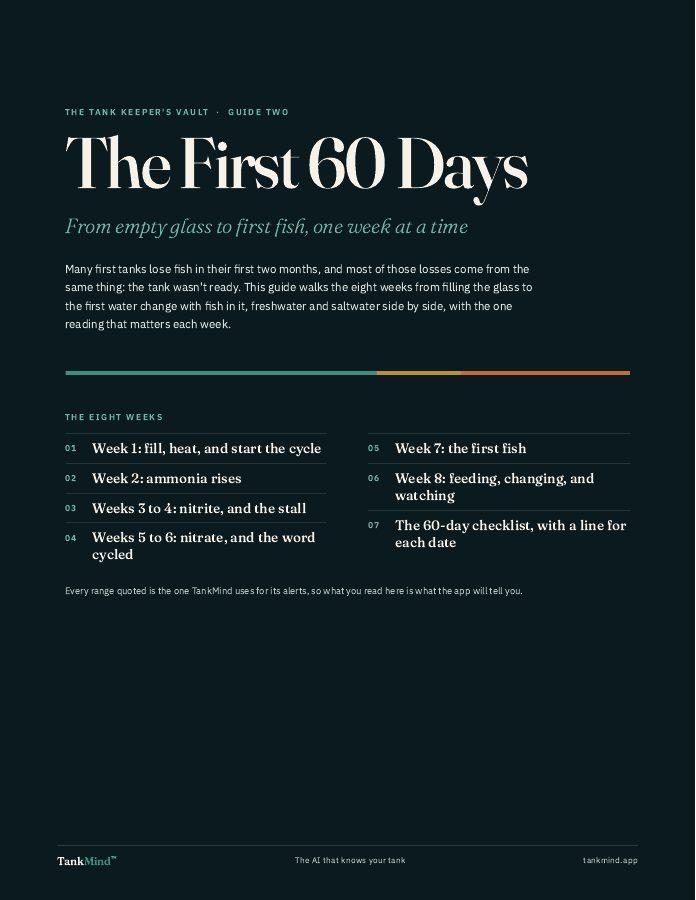
The First 60 Days
From empty glass to first fish, one week at a time
Get the free guideStart your free tank log