Your Guppy Just Had Babies: How to Raise Fry
November 18, 2026
My guppy just had babies: what do I do right now?
Move the fry away from adult fish as soon as possible, or give them enough dense cover to hide in, because adult livebearers including the mother will eat newborn fry if given the chance. Guppy fry are fully formed and free-swimming from the moment they are born. They need no parental care and can start eating right away. Your job in the first hour is simply to keep them from being eaten, and then to set up conditions where they can grow.
Why guppies give birth to live, free-swimming babies
Guppies are livebearers, meaning the female carries and develops the young inside her body and releases fully formed, swimming fish rather than laying eggs. The same is true of platies, mollies, and swordtails. Because livebearer fry arrive ready to move and feed, they do not need a nest, a parent standing guard, or any special hatching setup. What they do need is protection from tankmates and food small enough to eat.
A female guppy, platy, molly, or swordtail can drop a new brood roughly once a month, with most sources putting the interval at about 4 to 6 weeks depending partly on water temperature. A single brood commonly numbers anywhere from about 20 to 100 fry, sometimes more. Young females tend to deliver fewer fry, and large, mature females more. Female livebearers can also store sperm, so a female can keep producing broods long after her last contact with a male, even if no males are in the tank at all.
The three ways to protect livebearer fry
There are three practical approaches, and the right one depends on your setup.
Option 1: A breeder box or breeder net. A breeder box or net is a small enclosure that hangs inside or floats in your main tank. You put the pregnant female in it shortly before she gives birth. Once she has released all of her fry, you return her to the main tank so she cannot eat the babies. The fry stay in the box until they are bigger. The drawback is that breeder boxes are small, and fry raised in confined spaces may not grow as well as those in a larger tank. Once the fry are noticeably bigger and stronger, move them to a proper grow-out tank.
Option 2: A separate birthing or fry tank. A dedicated tank gives fry the most room to develop and makes feeding and water changes easier to manage. The pregnant female goes into the separate tank before she gives birth, is returned to the main tank after releasing all fry, and the fry grow out in the separate setup. This is the approach that gives you the most control.
Option 3: Heavy planting in the main tank. In a well-planted community tank, some livebearer fry usually survive without any separation, because dense plants and decor give them places to hide until they grow large enough to swim safely with the adults. Floating plants are particularly useful cover for newborn fry, and they work best when combined with plants or other cover lower in the tank as well. This method produces lower survival rates than the first two options, but it requires no extra equipment.
How to set up a fry tank that actually works
If you are using a separate tank or a grow-out tank, filtration is the detail most beginners get wrong. A fry tank needs gentle filtration that cannot suck in the babies. A sponge filter is the standard choice. If you are using a powered filter, fit a sponge pre-filter over the intake. Standard filter intakes will trap or kill newborn fry.
Beyond filtration, keep the tank stable and clean. Fry are fed often and produce waste quickly, so the water in a fry tank fouls faster than in a lightly stocked adult tank.
Feeding guppy fry: what, how much, and how often
Newborn guppy fry are large enough to eat finely crushed or powdered flake food from birth. You do not need to source special food to get started, though commercial fry foods are a good addition. Newly hatched baby brine shrimp is a recommended live food alongside powdered flake and commercial fry foods, and many keepers find it noticeably improves growth.
Feed small amounts at least about three times a day rather than one adult-sized meal. Each portion should be small enough that the fry finish it. Remove any uneaten food promptly, because leftover food fouls the water in a fry tank quickly when you are feeding multiple times daily. Frequent water changes are important for the same reason: regular feeding builds up waste fast, and clean water keeps fry healthy and growing.
When can fry go back into the main tank?
Fry can rejoin the adults once they are too big to fit in any adult fish's mouth. For livebearer fry in a tank of peaceful fish, this usually takes roughly 3 to 6 weeks depending on how fast they grow. Guppy fry reach sexual maturity at about 2 to 3 months old, with males maturing at around 2 months and females at around 3 months.
Before you reintroduce them to a tank that holds both males and females, think ahead. Livebearers are prolific breeders, and a tank with both sexes can fill with far more fish than you planned for. It is worth deciding early whether you want to raise all the fry, rehome them, or separate males and females before maturity.
One more thing worth knowing: guppies released from aquariums have established wild populations well outside their native range, and in the wild they cause harm to native species including by eating native fish eggs. Never release aquarium fish into natural waterways.
Frequently asked questions
How many babies will my guppy have?
A single livebearer brood commonly numbers from about 20 to 100 fry, sometimes more. Young females tend to deliver smaller broods, and large, mature females tend to deliver larger ones. If your guppy is delivering for the first time, expect a number toward the lower end of that range.
Can guppy fry survive in a community tank without separation?
Some will, yes. In a well-planted tank with enough dense cover, a portion of the fry usually survive by hiding until they grow large enough to be safe with adults. The survival rate is lower than with a breeder box or separate tank, but it does happen. Floating plants combined with cover lower in the tank give the best results.
Why is my female guppy having babies again when there are no males in the tank?
Female livebearers can store sperm from a single mating and use it to produce several successive broods. A female can keep giving birth for some time after her last contact with a male, so repeated births with no male present are entirely normal and not a sign that anything is wrong.
How long before guppy fry can join the adult fish?
Fry can rejoin adults once they are too big to fit in an adult fish's mouth. In a tank of peaceful fish this typically takes roughly 3 to 6 weeks, depending on how well and how often you feed them and how fast they grow.
How soon will my guppy have another brood?
A female guppy can deliver a new brood roughly once a month, with most sources citing about 4 to 6 weeks between broods. Water temperature affects timing. Because females can store sperm, you should expect repeated broods even if she is now housed without males.
If you want help matching your fry setup to your actual water readings, the TankMind /diagnose tool lets you enter your parameters and get specific guidance for your tank.
Want to keep your own tank steady? Track your parameters free with TankMind.
If this was useful, this tells Google to surface TankMind more often in your Search results.
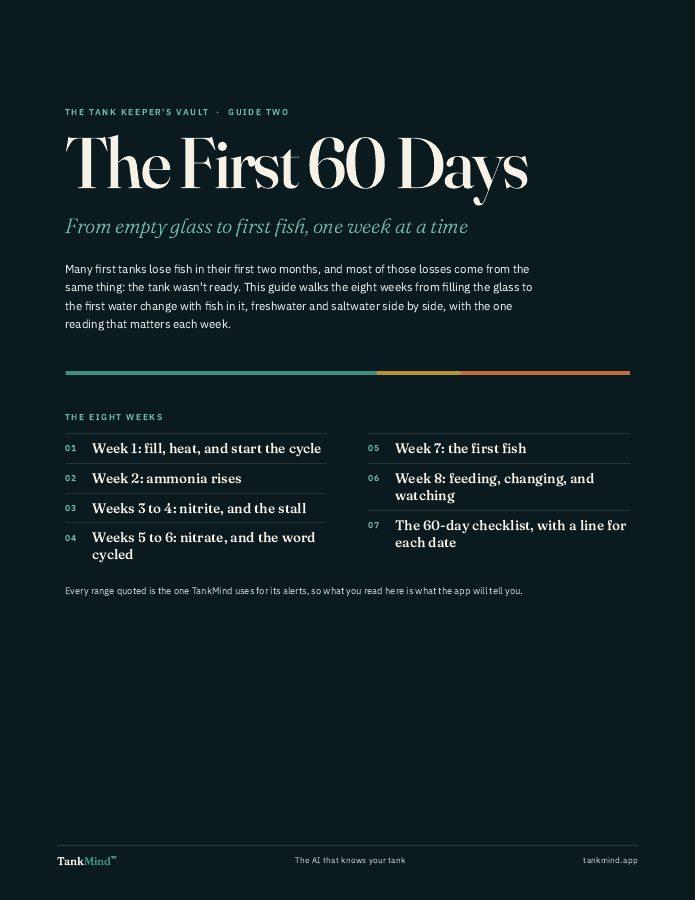
The First 60 Days
From empty glass to first fish, one week at a time
Get the free guideStart your free tank log